Role: Team Leader
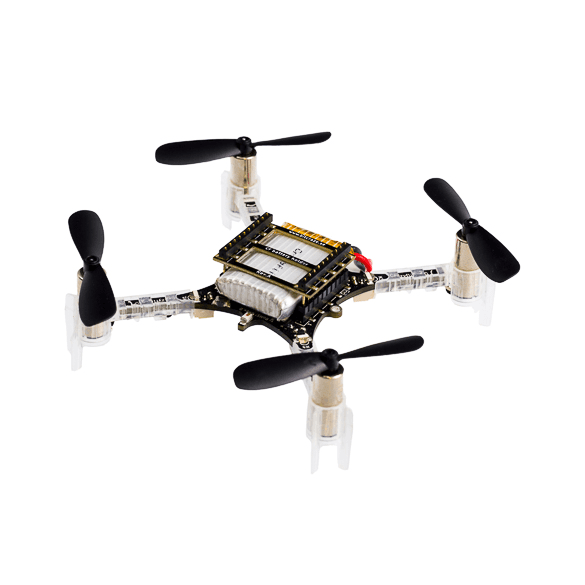
This project develops a micro-drone capable of autonomous indoor victim search with distributed swarm mapping. The design is constrained primarily by mass and energy, so the airframe, sensing, and compute stack were co-optimised to maximise flight time while maintaining sufficient perception fidelity for SLAM and obstacle avoidance.
Flight Control and Autonomy Separation
Low-level stabilisation runs on the integrated flight controller with tuned PID loops, while high-level autonomy is executed on a companion microcontroller. This guarantees deterministic control timing even when mapping and communication workloads fluctuate, preventing perception latency from destabilising the vehicle.
ToF Array and Custom Multiplexer PCB
Indoor mapping requires full azimuth coverage at short range, which is achieved using an array of eight time-of-flight sensors mounted around the airframe. A custom multiplexer PCB was developed to schedule each sensor in a deterministic time slice, preventing I2C contention while maintaining a fixed update rate for occupancy grid fusion.
Surface-mount implementation minimised mass and allowed local decoupling at each sensor to isolate them from motor-induced voltage ripple. The selected sensor provides an 8×8 depth grid per module, enabling direct spatial updates without mechanical scanning while remaining within the power budget.
State Estimation
Velocity is estimated using optical flow fused with IMU data to reduce drift in GPS-denied environments. The optical flow module is mechanically isolated from the propulsion frame to suppress high-frequency vibration that would otherwise corrupt the velocity estimate and degrade SLAM performance.
Powertrain Trade Study
Motor and battery selection was performed using a coupled performance model rather than independent component choice. The analysis computes thrust-to-weight ratio, hover throttle, hover current, and projected flight time while accounting for the mass of both motors and batteries. This reveals the point where additional battery capacity reduces endurance due to increased hover power.
The final configuration operates within the motor’s peak efficiency region at hover, reducing thermal load and preserving control authority for avoidance manoeuvres. The model also incorporates the power draw of the sensing and compute stack, ensuring autonomy features remain within the electrical budget.
Full propulsion trade study:
Swarm Mapping and Ground Station
Each drone builds a local occupancy grid using its depth array and transmits compressed map updates to a ROS2 ground station where a global map is assembled. This distributes computation across the swarm while maintaining shared situational awareness for coordinated search.
Full Run Validation
The system has completed full autonomous runs including take-off, indoor navigation, obstacle avoidance, and mapping passes under competition conditions. These tests validated the sensor scheduling strategy, power budget, and state estimation pipeline during sustained flight.